Next Gen Processors
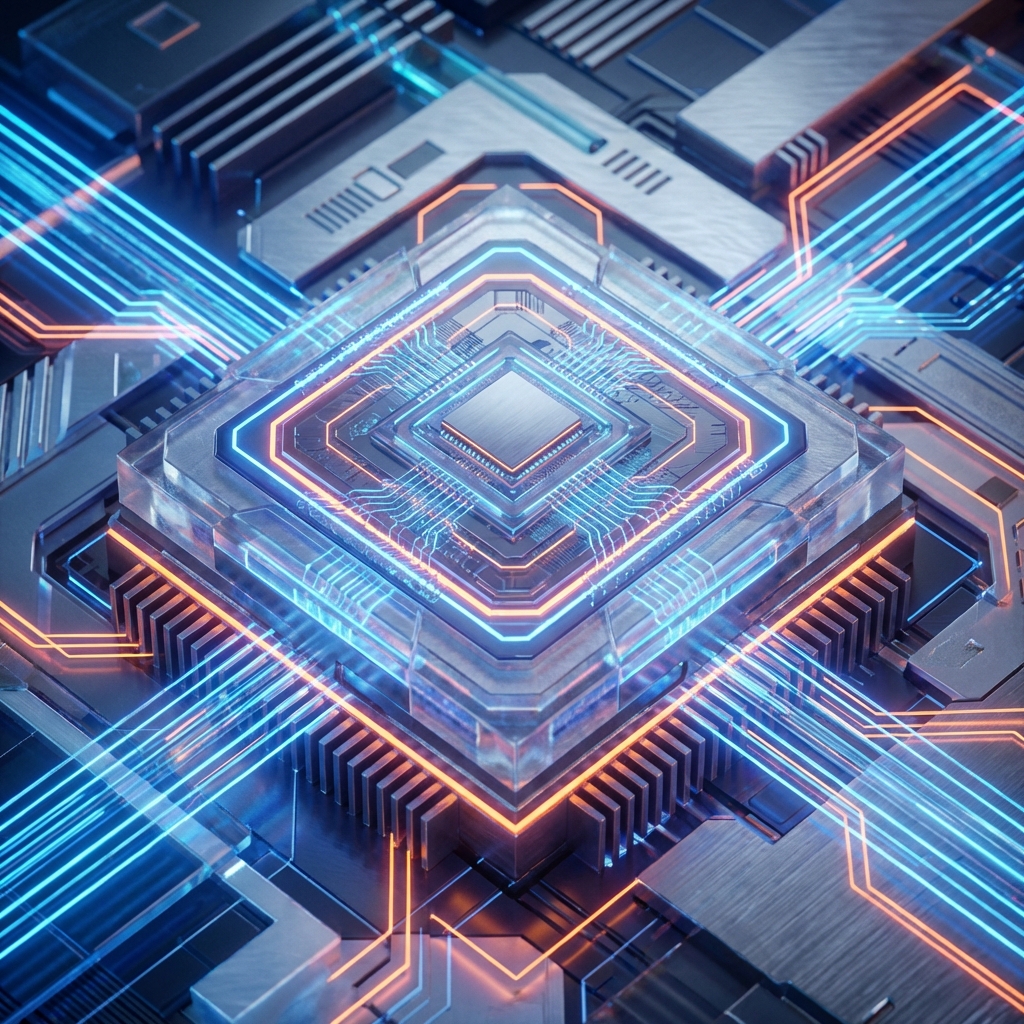
The demise of Moore's Law has been greatly exaggerated, but its nature has changed. We are exiting the era of general-purpose monolithic CPUs and entering the golden age of specialized accelerators, chiplets, and novel architectures defined by efficiency rather than raw clock speed.
The Heterogeneous Compute Era
For decades, Intel's x86 architecture dominated. You threw a faster CPU at a problem, and the software grew faster. Today, physics has imposed limits on thermal density. You can't just crank up the clock speed without melting the chip.
The solution is Heterogeneous Computing. A modern Apple Silicon chip or Intel Ultra chip is not just a CPU. It contains:
- NPU: Neural Processing Unit for AI tasks.
- GPU: Graphics Processing Unit for rendering and parallel math.
- ISP: Image Signal Processor for camera data.
- Secure Enclave: For encryption keys.
Software now dispatches tasks to the specific part of the chip designed for it. This is why a phone can run a local LLM while preserving battery life.
Chiplets: Lego Blocks of Silicon
Manufacturing a massive monolithic die is risky. One defect ruins the whole chip. AMD pioneered the "Chiplet" revolution, and Intel has followed. Instead of one big chip, they print smaller "tiles" (compute tile, IO tile, graphics tile) and stitch them together using advanced packaging (like TSMC's CoWoS or Intel's Foveros).
This allows mixing and matching. The IO tile can be made on an older, cheaper process node (like 12nm), while the CPU cores are on the bleeding edge (3nm). This optimizes cost and yield.
RISC-V: The Open Source Rebellion
ARM dominates mobile, and x86 dominates PC/Server. But a third player is rising: RISC-V. It is an open-standard Instruction Set Architecture (ISA). It's the "Linux of Chips."
Companies like Google, Qualcomm, and Nvidia are investing in RISC-V because it frees them from licensing fees and allows for custom extensions. China is heavily backing RISC-V to inoculate itself against Western sanctions. We are seeing RISC-V replacing ARM in microcontrollers, SSD controllers, and soon, AI accelerators.
AI-First Silicon
The demand for AI is reshaping the roadmap. We are seeing chips designed solely for "Matrix Multiplication"—the math behind neural networks.
Groq (not the Musk AI, the chip company) created the LPU (Language Processing Unit), a deterministic chip that puts massive memory bandwidth on-die, allowing purely sequential LLM token generation at speeds 10x faster than traditional GPUs.
Cerebras took the opposite approach: The Wafer-Scale Engine. Instead of cutting the silicon wafer into chips, the entire wafer is the chip. It creates a processor the size of a dinner plate with 4 million cores, specifically for training massive AI models.
Conclusion
Hardware is cool again. The stagnation of the 2010s is over. The Cambrian explosion of chip variety means that software developers have more toys to play with, but also more complexity to manage. The "End of Moore's Law" was actually the beginning of something much more interesting.