5G Networks Expand to Rural Areas
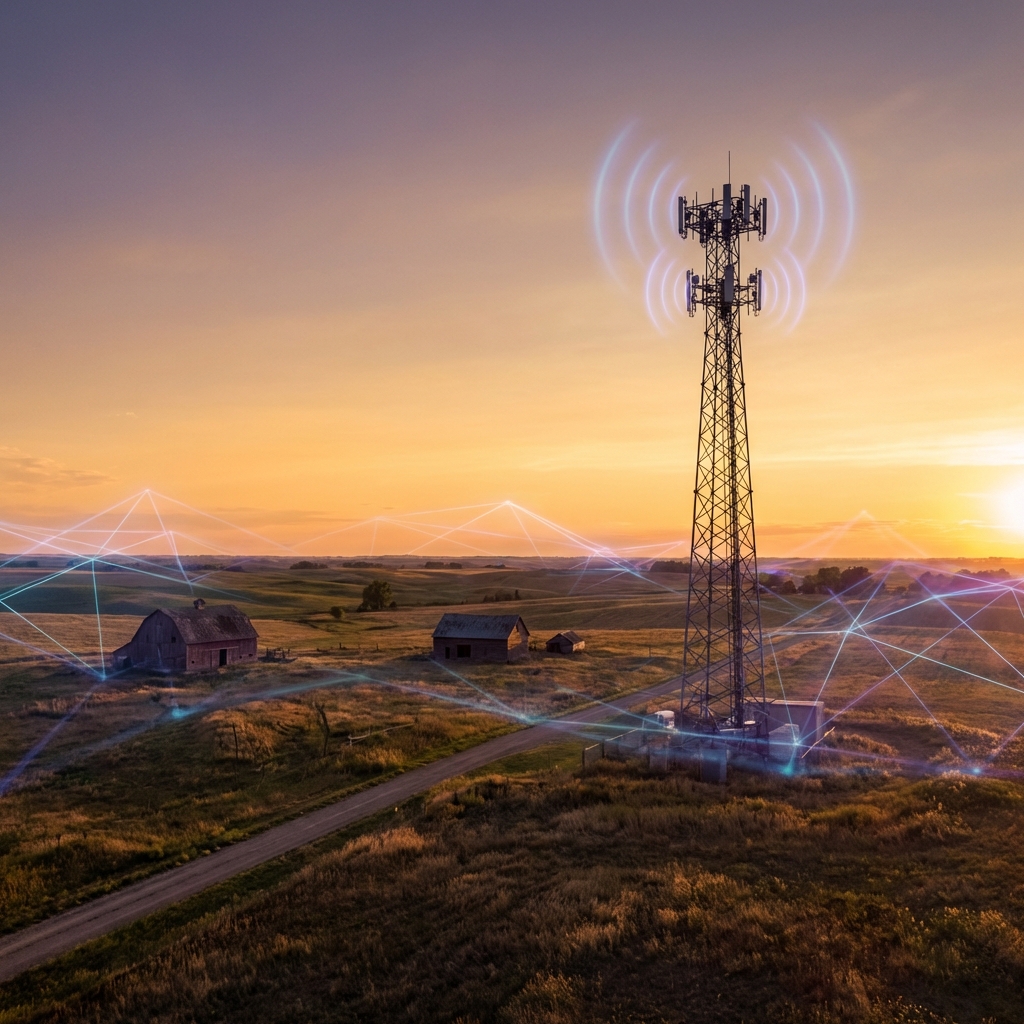
The expansion of 5G networks into rural areas marks a pivotal moment in the global effort to close the digital divide, promising to revitalize agricultural economies, enhance telemedicine capabilities, and democratize access to high-speed information.
The Digital Divide: A Historical Context
For decades, a stark disparity has existed between urban centers and rural communities regarding internet connectivity. While city dwellers enjoyed the rapid evolution from dial-up to broadband and eventually fiber-optics, large swathes of the countryside remained in digital darkness. This "digital divide" has had profound economic and social consequences, limiting educational opportunities, hindering business growth, and exacerbating the rural-urban economic gap.
The arrival of 5G represents more than just a speed upgrade; it is a fundamental shift in infrastructure economics. Unlike fiber, which requires expensive trenching and physical cabling to every premise, 5G Fixed Wireless Access (FWA) acts as a "fiber through the air" solution, beaming gigabit-speed internet from a central tower to receivers miles away. This architecture drastically reduces the cost per user (CPU) for deployment, making the business case for rural connectivity finally viable for major telecommunications providers.
Technological Enablers: Low-Band vs. mmWave
Understanding the rural 5G expansion requires differentiating between the "flavors" of 5G. The headline-grabbing speeds of 5G often refer to millimeter-wave (mmWave) technology—extremely high-frequency bands that offer incredible speed but suffer from poor range and penetration. This is ideal for dense stadiums but useless for sprawling farmlands.
The revolution in rural areas is driven by Low-Band 5G (sub-1GHz) and Mid-Band 5G (C-Band). Low-band frequencies possess excellent propagation characteristics, capable of traveling dozens of miles and penetrating thick walls or foliage. While speeds are lower than mmWave—typically ranging from 50Mbps to 250Mbps—they are vastly superior to the 3Mbps DSL lines or erratic satellite connections currently plaguing these regions.
Mid-Band spectrum, recently auctioned by governments worldwide, offers the "Goldilocks" solution: a balance of range and speed, delivering consistent 300-500Mbps service over a radius of several miles. This layering of spectrum bands allows carriers to blanket wide areas with baseline coverage while targeting denser rural towns with higher capacity.
Smart Agriculture: The Killer App for Rural 5G
Critically, the primary economic driver for rural 5G is not consumer streaming, but "Precision Agriculture." Modern farming is increasingly data-driven, relying on a mesh of IoT sensors to monitor soil moisture, crop health, and equipment status.
Use Case: Autonomous Tractors
John Deere and other manufacturers are rolling out fully autonomous tractors that run 24/7. These machines generate terabytes of visual and sensor data that must be processed for navigation and task execution. 5G's low latency allows for real-time remote monitoring and control, ensuring safety and efficiency.
Use Case: Drone Monitoring
Multispectral imaging drones can scan fields to detect pest infestations or hydration issues days before they are visible to the human eye. With 5G, this high-resolution imagery can be uploaded instantly to the cloud for AI analysis, providing farmers with actionable insights within minutes rather than hours.
According to a 2025 report by the AgTech Institute, 5G-enabled precision agriculture could increase global crop yields by up to 20% while reducing water usage by 30% and pesticide application by 40%. This efficiency is crucial for global food security as the population continues to grow.
Telemedicine: Saving Lives in Remote Areas
Healthcare access is another critical crisis in rural areas, where hospitals are often hours away. 5G enables the next generation of telemedicine, moving beyond simple video calls to remote diagnostics and even telesurgery.
High-definition, low-latency video allows specialists in metropolitan medical centers to examine patients in rural clinics remotely. For example, a dermatologist can view skin lesions in 4K resolution in real-time, or a stroke specialist can guide a rural nurse through emergency triage procedures using augmented reality (AR) headsets.
Furthermore, "Hospital at Home" initiatives leverage 5G-connected wearables to monitor vital signs continuously. If a patient's heart rate spikes or oxygen levels drop, the system alerts healthcare providers immediately. This capability allows elderly residents to age in place safely, reducing the strain on underfunded rural nursing facilities.
Economic Revitalization and Remote Work
The COVID-19 pandemic normalized remote work, precipitating a migration from expensive cities to more affordable rural locations. However, this trend was capped by connectivity limitations. With robust 5G, rural towns can attract a new class of "digital nomads" and tech workers.
This influx of high-income residents boosts local economies, supporting Main Street businesses and expanding the tax base. Moreover, it allows local youth to pursue careers in the digital economy without feeling forced to leave their hometowns. "Zoom Towns"—communities that boom due to remote workers—are becoming a measurable economic phenomenon.
Educational Equity
The "homework gap" has severely disadvantaged rural students who cannot access online resources or participate in digital learning. 5G FWA provides a stable connection for households that cable providers have ignored. This access ensures that a child in a remote farmhouse has the same access to the Library of Congress, Khan Academy, and coding bootcamps as a child in Silicon Valley.
Schools are also leveraging private 5G networks to support secure, high-bandwidth applications on campus, including VR field trips and cloud-based collaboration tools.
Challenges and the Road Ahead
Despite the promise, challenges remain. The deployment of 5G infrastructure is capital intensive. While government subsidies like the Rural Digital Opportunity Fund (RDOF) in the US provide billions in incentives, the ROI for carriers in sparsely populated areas remains thin.
Furthermore, topography presents physical barriers. Mountains and deep valleys can block signals, requiring creative solutions like satellite backhaul integration or localized mesh networks. There is also the issue of device affordability; upgrading to 5G routers and smartphones is a cost burden for lower-income rural households.
Security is another paramount concern. As critical infrastructure like farms and hospitals comes online, the attack surface for cyber threats widens. Implementing Zero Trust architectures and robust endpoint security on IoT devices is non-negotiable.
Conclusion
The expansion of 5G into rural areas is not merely an infrastructure upgrade; it is a civil rights victory. It ensures that geography no longer dictates economic destiny. As the networks light up, we are witnessing the reintegration of the rural economy into the global digital fabric, releasing untapped potential in agriculture, healthcare, and human capital. The "Smart Farm" and the "Connected Village" are no longer futurist concepts—they are becoming the new reality.