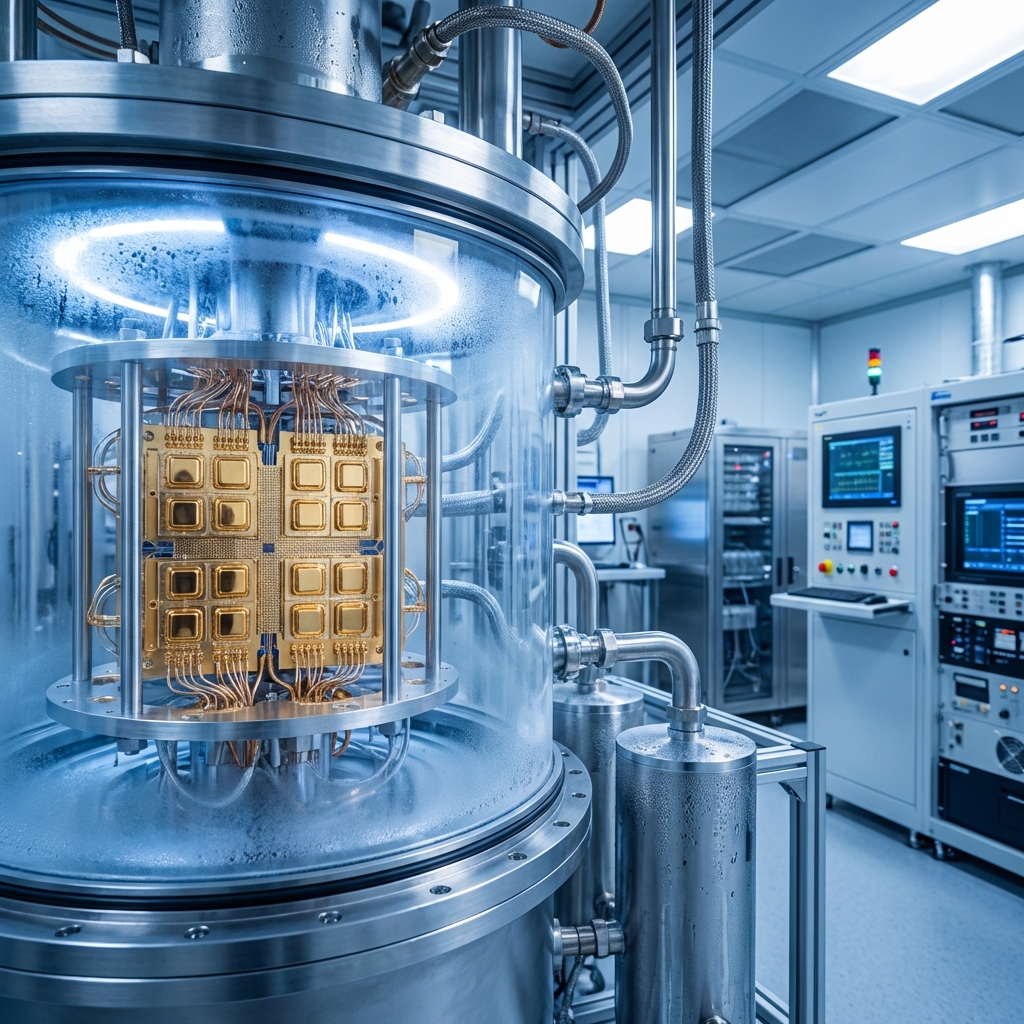
Quantum Computing Breakthrough
The milestone of 'Quantum Advantage' has historically been a moving target, but recent breakthroughs in error correction by Google Quantum AI and IBM have shifted the timeline from 'decades away' to 'engineering imminent,' particularly in the realm of logical qubits.
The Noise Problem: Why Qubits Fail
Unlike classical bits which are 0 or 1, qubits exist in superposition. However, they are incredibly fragile. A stray photon or a temperature fluctuation of a millikelvin can cause "decoherence," causing the qubit to collapse and lose information. This noise has been the primary bottleneck.
For years, the industry focus was on increasing the number of physical qubits (getting to 100, then 1,000). But 1,000 noisy qubits are useless if they produce errors faster than you can calculate.
The Breakthrough: Logical Qubits
The recent breakthrough published in Nature involves "Quantum Error Correction." By entangling multiple physical qubits (say, 49 of them) to form a single "Logical Qubit," the system can detect and correct errors without collapsing the quantum state.
IBM's "Heron" processor and Google's "Sycamore" latest iteration have demonstrated that as they increase the number of physical qubits used for error correction, the error rate actually decreases. This proves that we have crossed the threshold where scale helps rather than hurts. We are now in the era of "Utility-Scale" quantum computing.
Materials Science: The First Killer App
While people talk about cracking encryption (Shor's Algorithm), that requires millions of qubits. The immediate breakthrough is in simulation. A classical supercomputer cannot simulate the molecular behavior of caffeine accurately—the quantum interactions are too complex. A quantum computer maps naturally to this.
Pharmaceutical companies are already booking time on these new machines to simulate protein folding and drug interactions. This could shave years off the drug discovery pipeline. Similarly, battery manufacturers are using it to find new electrolytes for EV batteries that are denser and safer.
The Different Modalities
The race is not won by a single technology.
- Superconducting Qubits (IBM, Google): Fast, but require near-absolute zero cooling.
- Trapped Ions (IonQ, Quantinuum): Slower, but extremely stable and high connectivity.
- Neutral Atoms (Pasqal, QuEra): Use lasers to hold atoms in arrays; highly scalable.
- Photonic (PsiQuantum): Uses light; runs at room temperature but needs massive scale.
Each modality has strengths. We may see a future where specific machines are used for specific types of problems.
Conclusion
We are leaving the "NISQ" (Noisy Intermediate-Scale Quantum) era. The engineering path to a fault-tolerant machine is now clear, even if it is still a difficult road. The "Quantum Winter" has been cancelled.