Cloud Pricing Trends
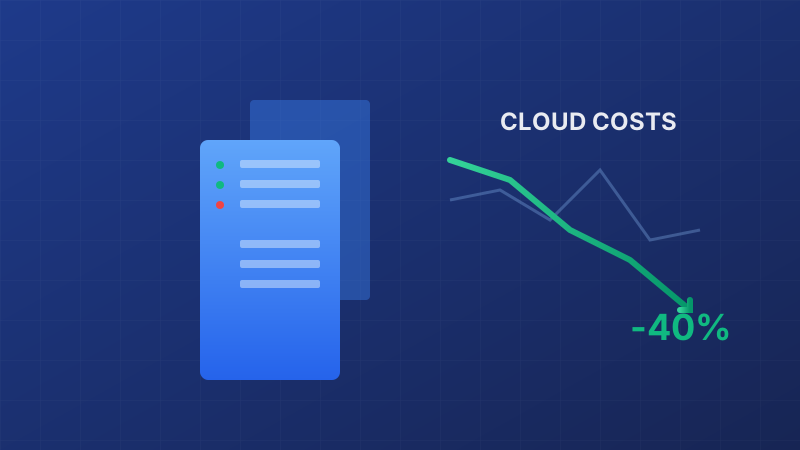
The era of 'cheap cloud' is officially over. As AI workloads monopolize GPU capacity and energy prices fluctuate, CIOs are facing a new reality of volatility, forcing a strategic pivot from pure scalability to rigorous financial operations (FinOps).
The Perfect Storm: Why Prices are Rising
For a decade, cloud pricing followed Moore's law: better performance for the same price, or the same performance for less. That curve has broken. Several factors have converged to drive costs up.
- The AI Premium: The demand for Nvidia H100s and A100s has created an auction market for compute. Hyperscalers (AWS, Azure, GCP) are investing billions in new clusters. They are passing these CapEx costs down to the consumer, not just in GPU instances, but across the board to subsidize the build-out.
- Energy Inflation: Data centers are massive energy hogs. The global spike in energy prices, driven by geopolitical instability, flows directly to the bottom line. In Europe, some availability zones have seen price hikes of 20% purely due to electricity costs.
- The End of Zero Interest Rates (ZIRP): Capital is no longer free. The cost of borrowing to build new data centers has tripled. Tech companies are shifting from "growth at all costs" to profitability, ending the deep discounts and credits used to capture market share.
The Rise of FinOps: Optimization as a Service
This inflationary environment has birthed "FinOps"—Cloud Financial Management. It brings financial accountability to the variable spend model of cloud. It's cultural shift: engineering teams now have "cost" as a KPI alongside "uptime" and "latency."
Strategies include:
- Spot Instance Arbitrage: Using transient spare capacity for fault-tolerant workloads (like batch processing), saving up to 90%.
- Rightsizing: Automated tools that scan for idle resources (the "zombie servers") and shut them down. Studies show 30% of cloud spend is pure waste—resources provisioned but never used.
- Savings Plans: Committing to a specific dollar amount of spend for 1-3 years in exchange for lower rates.
Repatriation: Moving Back On-Prem?
A controversial trend is "Cloud Repatriation." Some companies, like 37signals, have famously moved off the cloud to bare-metal servers, saving millions. For predictable, steady-state workloads, owning your hardware is often cheaper than renting it.
Hybrid cloud is emerging as the winner. Burst to the public cloud for peak traffic or AI training; keep the steady database and core logic on private infrastructure (or colocation). This avoids the "Hotel California" effect of cloud data egress fees.
Multi-Cloud Strategy: Leverage or Liability?
"Multi-Cloud" (using AWS and Azure simultaneously) is often pitched as a negotiation lever. However, the data gravity problem makes this hard. Moving terabytes of data between clouds is slow and expensive. The real value of multi-cloud is resilience, not price arbitrage. It ensures that if 'us-east-1' goes down, your business doesn't evaporate.
Conclusion
The cloud is maturing from a wild frontier to a utility. Just as factories manage their electricity bill, digital companies must manage their cloud bill. The days of "swipe the credit card and spin up a cluster" are being replaced by rigorous procurement processes. Innovation continues, but the price of admission has gone up.