AR/VR Headsets See Mass Adoption
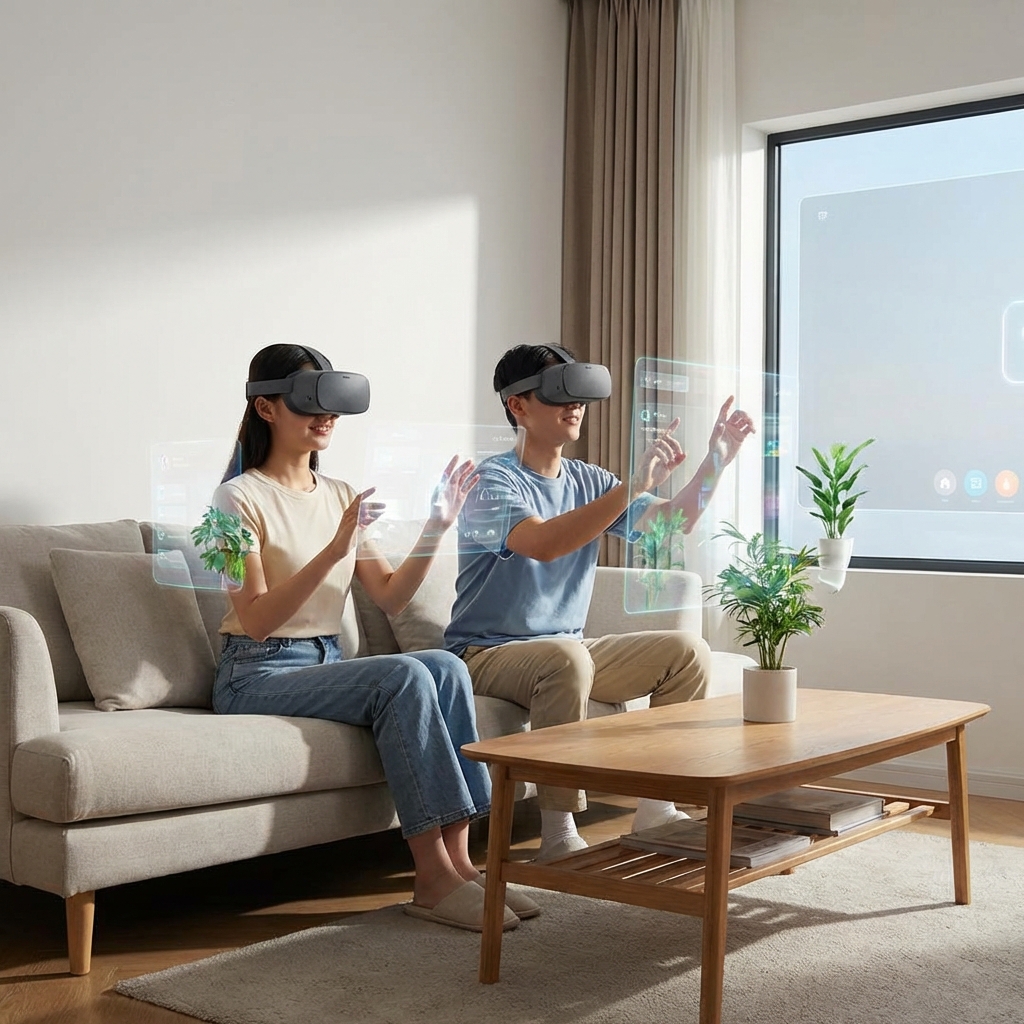
The mass adoption of Augmented and Virtual Reality represents the next major computing platform shift, moving us from the era of 'looking at' screens to 'living inside' digital experiences, fundamentally altering how we interact with information, entertainment, and each other.
Beyond the Hype: The Plateau of Productivity
For years, AR and VR were stuck in the "Trough of Disillusionment." The hardware was bulky, the battery life was abysmal, and the content ecosystem was barren. However, 2025-2026 marks the widespread entry into the "Plateau of Productivity." The convergence of Micro-OLED displays, pancake lenses, and powerful mobile chipsets has finally delivered hardware that is usable for hours without nausea or fatigue.
We are seeing a bifurcation in the market: Passthrough MR (Mixed Reality) headsets that use cameras to blend digital objects with the real world, and Optical AR glasses that project light directly into the user's eye. Both form factors are seeing exponential growth in adoption, driven by falling component costs and the entry of major ecosystem players like Apple, Meta, and Google.
The Consumer Use Cases Driving Sales
While gaming remains a foundational pillar, it is no longer the sole driver. "Spatial Computing" has repositioned the headset as a productivity device. Users can spawn infinite virtual monitors in their living room, turning a cramped apartment into a massive command center.
Immersive Media: Sports broadcasting is being revolutionized. Users can sit courtside at an NBA game or stand on the sidelines of a premier league match from their couch. Volumetric video captures allow viewers to move around the action, breaking the tyranny of the director's camera angle.
Virtual Tourism and Presence: "Telepresence" is replacing the video call. Instead of staring at a grid of faces on Zoom, users share a virtual space with full-body avatars that track facial expressions and eye movement. This sense of "co-presence" significantly reduces Zoom fatigue and enhances social connection for remote families.
The Hardware Evolution: Smaller, Lighter, Faster
The engineering breakthroughs enabling this adoption cannot be overstated.
- Optics: The shift from Fresnel lenses to Pancake lenses has reduced the optical stack thickness by 40%, moving the center of gravity closer to the face and improving comfort.
- Displays: Micro-OLEDs are delivering 4K resolution per eye, eliminating the "Screen Door Effect" that plagued early headsets. This text readability is crucial for productivity use cases.
- Input: We have moved beyond clunky plastic controllers. Hand tracking and eye tracking are now standard. The interface feels magical—you look at an icon and tap your fingers to select it. This "intent-based computing" removes the friction of peripherals.
The Ecosystem War: Walled Gardens vs. Open Metaverse
A fierce battle is waging for the soul of the spatial internet. On one side are the "Walled Gardens"—proprietary app stores where the platform holder bans side-loading, takes a 30% cut, and strictly controls the user experience. On the other side is the "Open Metaverse" built on WebXR standards, allowing experiences to run directly in a browser without installation.
The Open Metaverse advocates for interoperability—your digital avatar and assets (NFTs or otherwise) should travel with you from one world to another. Currently, the Walled Gardens are winning on polish and performance, but the long-term trend of the web suggests that open standards eventually catch up.
Social Implications: Isolation vs. Connection
Critics argue that mass adoption of VR leads to a "Wall-E" future of isolation, where humans disconnect from physical reality. Proponents argue the opposite: that AR/VR allows us to transcend physical limitations. A disabled person can hike Mount Everest in VR; a socially anxious teenager can practice social interaction in a safe, controlled virtual environment.
However, the risks of "Hyper-Reality" are real. When digital overlays become better than reality, we risk neglecting our physical environments. "AR Ad-Blockers" for real-life billboards are already being developed, but so are "AR Skins" that obscure homelessness or urban decay from the viewer, creating a sanitized filter bubble of the physical world.
The Enterprise and Education Angle
While consumer adoption grabs headlines, enterprise adoption pays the bills. Walmart uses VR to train managers in empathy; Boeing uses AR to guide wire assembly technicians (improving speed by 30% and accuracy by 90%).
In education, rote memorization is being replaced by experiential learning. Medical students dissect virtual cadavers; history students walk through a reconstruction of Ancient Rome. Retention rates for VR learning are consistently proven to be 40-60% higher than textbook learning because the brain encodes the experience as a spatial memory, not just abstract data.
Conclusion
We are witnessing the "iPhone moment" for Spatial Computing. The hardware is ready, the software is maturing, and the social stigma of wearing a computer on your face is fading. Over the next five years, the smartphone will not disappear, but it will be unbundled—its screen floating in the air in front of us, its audio whispered into our ears, and its computing power tucked away in our pockets. The world is about to get a lot more immersive.